There were several interesting stories that I learned about the schloss that I just had to share. One was in the Reinhardt days and two were from WWII.
The first one was about a particular statue that Reinhardt bought to furnish his palace. Remember the schloss had changed hands often and the art work was sold off through the centuries.
Max was a director and an artist, but he also was a businessman. He had enough money to buy and rebuild the schloss...
He had seen this statue over a building in Vienna and liked it. He thought it would be great for his entrance hall(the Great Hall we call it now). He wasn't able to buy it himself, so he sent a trusted cousin(female) to do the transaction. No one is sure exactly why, but maybe because she would be underestimated by the owner of the statue.
So she knocks on the door and says that Max Reinhardt really likes your Madonna and would like to have it. The owner of the house refuses saying the Madonna is protecting my girls. The cousin(who's name I never got) is a bit taken aback and realizes the sign is advertising a brothel. So oops. But after going back to Max and then back to the owner of the brothel(realizing maybe that she has a price for this along with everything else). She did. So Max got his Madonna. I don't know what he paid for it in the end, but it is very nice.
So the next little vignette takes place in the 1940's. The Schloss was seized by the Nazi's after the Anschluss. The schloss was fought over by member of the Nazi party. It was used a staging area for people who were going to the Eagle's Nest in Berchtesgarten. (Berchtesgarten is on the other side of the Untersberg so close...) But a Princess who was a fan of Reinhardt managed to finagle the schloss for a while and shipped out most of Max's things to him in California. I don't know how, and would love to know. Because it was 16 crates of stuff. She got 16 crates of an enemy of Nazi Germany(and a Jew) stuff across war torn Europe to California. I mean this wasn't just a few suitcases of clothes and paying a extra baggage fee on Lufthansa!
This blows my mind. 16 crates of stuff! Across war torn Europe! To a Jewish director in the USA!
The final story had evidence scattered around the schloss. This was late in the war. An American bomber was flying over the area and was looking to drop his bomb. Engine trouble I think. He saw the lake and thought, Oh good a lake. So he dropped the bomb. Well the lake isn't really deep. So he blew most of the water out of it and the concussion broke all the windows in the lake side part of the schloss. So many areas have holes in the walls. My favorite is in the White Room. One of the portraits looks like he has a GSW in the forehead.
I don't have a photo of that, but here's one from the Chinese room.
Showing posts with label schloss leopoldskron. Show all posts
Monday, August 15, 2011
Monday, August 1, 2011
Leopoldskron part 2 or is it 3?
So now that we have some background on the owners and history of the schloss you understand the context of the place.
And as any good archivist knows, "Context is everything."
I mentioned that Max spent a great deal of time and money renovating the schloss. He created the library and redid the dining room with a Venetian theme.
And just in case you wondered who built the library he had a signature of sorts plastered into the ceiling in the very classic sign for the theatre. The mask on the left is a portrait of Max himself.
He also built an ampitheatre in the park so he could stage plays. Sadly the theatre was not built on solid ground and sank years ago, although there are still signs of it if you know where to look.
In fact the schloss itself was not built on solid ground, but the Archbishop took a page from the builders of Venice and used supports in the boggy ground to be the bedrock and foundation of the place. A problem with waterfront property, I guess.
After the Second World War was over the schloss was returned to Reinhardt's heirs. His widow offered the use of the place to several Harvard(yes I know...)grad students who came up with what is now referred to as the "Marshall Plan for the mind" to get former enemies to share ideas, cultures, and trust each other again. The Seminar was supposed to be a one time thing, but it was so popular with the participants that it continued on. Obviously. There have been some rather important people who attended sessions there. The Prince of Wales, and Ralph Ellison were two that I knew about from research(and cleaning) in the office. So it's very diverse.
The organization that runs the Seminar bought the place in the 1960's and so here we are. At least when it comes to ownership.
It was designated a historical place of interest by the Austrian government sometime back. From an artistic and historical standpoint you gotta love that.
And as any good archivist knows, "Context is everything."
I mentioned that Max spent a great deal of time and money renovating the schloss. He created the library and redid the dining room with a Venetian theme.
And just in case you wondered who built the library he had a signature of sorts plastered into the ceiling in the very classic sign for the theatre. The mask on the left is a portrait of Max himself.
He also built an ampitheatre in the park so he could stage plays. Sadly the theatre was not built on solid ground and sank years ago, although there are still signs of it if you know where to look.
In fact the schloss itself was not built on solid ground, but the Archbishop took a page from the builders of Venice and used supports in the boggy ground to be the bedrock and foundation of the place. A problem with waterfront property, I guess.
After the Second World War was over the schloss was returned to Reinhardt's heirs. His widow offered the use of the place to several Harvard(yes I know...)grad students who came up with what is now referred to as the "Marshall Plan for the mind" to get former enemies to share ideas, cultures, and trust each other again. The Seminar was supposed to be a one time thing, but it was so popular with the participants that it continued on. Obviously. There have been some rather important people who attended sessions there. The Prince of Wales, and Ralph Ellison were two that I knew about from research(and cleaning) in the office. So it's very diverse.
The organization that runs the Seminar bought the place in the 1960's and so here we are. At least when it comes to ownership.
It was designated a historical place of interest by the Austrian government sometime back. From an artistic and historical standpoint you gotta love that.
Sunday, July 31, 2011
Reinhardt and Leopoldskron
So now that you have the basics of how the schloss came to be it's time to move to the 20th century. So here enters the hero of the piece.
After the First World War Max Reinhardt bought the schloss and spent the next 20 years and a great deal of money renovating. As someone who spent the majority of her time in his office I can attest that it was worth every cent and second he lavished on the place. Here's one of my favorite views. This is looking out to the library from the Reinhardt office.
Many people have not heard of Max Reinhardt these days. So here's a few facts about him(thanks to the finding aid of the SUNY- Binghamton Special Collections, which holds the Reinhardt archives) Max Reinhardt started his work life as an actor. He was best known for his portrayals of old men, but he quickly tired of the scripts and the style of acting at the time and founded his own theatre in 1901. Known as Schall und Rauch it helped Max develop a directorial style for his later years. He moved around from Vienna, Salzburg, and Berlin during this time.
He quickly became a well known director who used new technologies and experimented with locations for his productions. This came in handy when he and Richard Wagner and Hugo von Hofmannsthal revived and expanded the Salzburg Festspiele. Reinhardt convinced the Archbishop to let him direct Hofmannsthal's play Jedermann(Everyman) in front of the Dom Cathedral to open the Festival. This is something they still do today at the opening of every festival, unless it rains, of course. Here's a shot of the front of the Dom on Palm Sunday. A partial view of what it could be like for the play.
After the war he left Berlin for Salzburg where he lived until 1938. As a Jew he was unwelcome in Austria after the Anschluss. All his property including Leopoldskron was seized by the Nazis because he was considered an enemy of the state. Luckily for Max he was in the U.S. at the time where he lived in until his death in 1943 at the age of 70. Some think losing the schloss broke his heart. I don't know about that, but it is known that he was saddened by it's loss to the Nazis. When his possessions(all 16 crates of them) were returned to him by an admirer he replied to her "Thank you, but what are 16 crates when one has lost Leopoldskron?".
So the schloss is still working it's magic on the owner. Like the original owner it was hard to leave the place that he loved.
After the First World War Max Reinhardt bought the schloss and spent the next 20 years and a great deal of money renovating. As someone who spent the majority of her time in his office I can attest that it was worth every cent and second he lavished on the place. Here's one of my favorite views. This is looking out to the library from the Reinhardt office.
Many people have not heard of Max Reinhardt these days. So here's a few facts about him(thanks to the finding aid of the SUNY- Binghamton Special Collections, which holds the Reinhardt archives) Max Reinhardt started his work life as an actor. He was best known for his portrayals of old men, but he quickly tired of the scripts and the style of acting at the time and founded his own theatre in 1901. Known as Schall und Rauch it helped Max develop a directorial style for his later years. He moved around from Vienna, Salzburg, and Berlin during this time.
He quickly became a well known director who used new technologies and experimented with locations for his productions. This came in handy when he and Richard Wagner and Hugo von Hofmannsthal revived and expanded the Salzburg Festspiele. Reinhardt convinced the Archbishop to let him direct Hofmannsthal's play Jedermann(Everyman) in front of the Dom Cathedral to open the Festival. This is something they still do today at the opening of every festival, unless it rains, of course. Here's a shot of the front of the Dom on Palm Sunday. A partial view of what it could be like for the play.
After the war he left Berlin for Salzburg where he lived until 1938. As a Jew he was unwelcome in Austria after the Anschluss. All his property including Leopoldskron was seized by the Nazis because he was considered an enemy of the state. Luckily for Max he was in the U.S. at the time where he lived in until his death in 1943 at the age of 70. Some think losing the schloss broke his heart. I don't know about that, but it is known that he was saddened by it's loss to the Nazis. When his possessions(all 16 crates of them) were returned to him by an admirer he replied to her "Thank you, but what are 16 crates when one has lost Leopoldskron?".
So the schloss is still working it's magic on the owner. Like the original owner it was hard to leave the place that he loved.
Friday, July 29, 2011
Schloss Leopoldskron
I can't remember if I posted anything about the history of the schloss. I don't think so. Not as a dedicated entry, of course. I know there were hints.
It is quite interesting(and I want to use more of the library and schloss photos I took) I'm sneaky that way. :D Here's my favorite photo of the schloss exterior. Two residences of a Prince-Archbishop of Salzburg.
So bear with me while we delve into the history of Schloss Leopoldskron. First we will set the scene with a few facts about Salzburg. Salzburg means salt castle in German. Also known as 'white gold' the salt mines in the area ensured that money poured into the region. It was one of the main reasons that Salzburg became an archbishopric so early. (Before the 1000's) Some salt mines still do operate in the region to this day. If anyone is interested in the history of salt and how important it was to the world economy check out this book, Salt, a world history by Mark Kurlansky.
So early on Salzburg had enough money to be an independent principality with an Archbishop as the head of the church and the political head of state. Known as a Prince-Archbishop until the early 1800's,(Napoleon and the Council of Vienna stripped the Prince part of the title in 1815 and Salzburg officially became a part of Austria.) they were the power in Salzburg. In fact Mozart's father was court composer to Archbishop Leopold Firmian. They even think a young Mozart played in the schloss for the Archbishop. It makes some sense, there's just no documentary evidence. Young Wolfgang played everywhere else why not at Schloss Leopoldskron for his father's patron?
So back to the early history of the schloss. Leopold Firmian... umm...acquired some land near a small lake in the countryside(he expelled a lot of the Protestants of Salzburg and gee look at all that wasted farmland) and decided to build himself a summer palace.
I gotta say this for him, he knew location. His plot of land was right between the Untersberg mountain and the city with great views of both, depending on which way you were facing. And as an added bonus it's waterfront property!
So the palace had to match both the location and the importance of the owner. As you can imagine, it took him quite some time to get exactly what he wanted.
He started it in 1736 and it was finished in 1744(right before he died) In keeping with artistic trends of the time he did it in the Baroque/rococo style. Lots of stucco work, marble, and giltwork. That man had no self-esteem issues whatsoever. Anyone who makes the Pope gasp at your audacity has a HUGE ego. (That was the whole expelling the Protestants deal.)
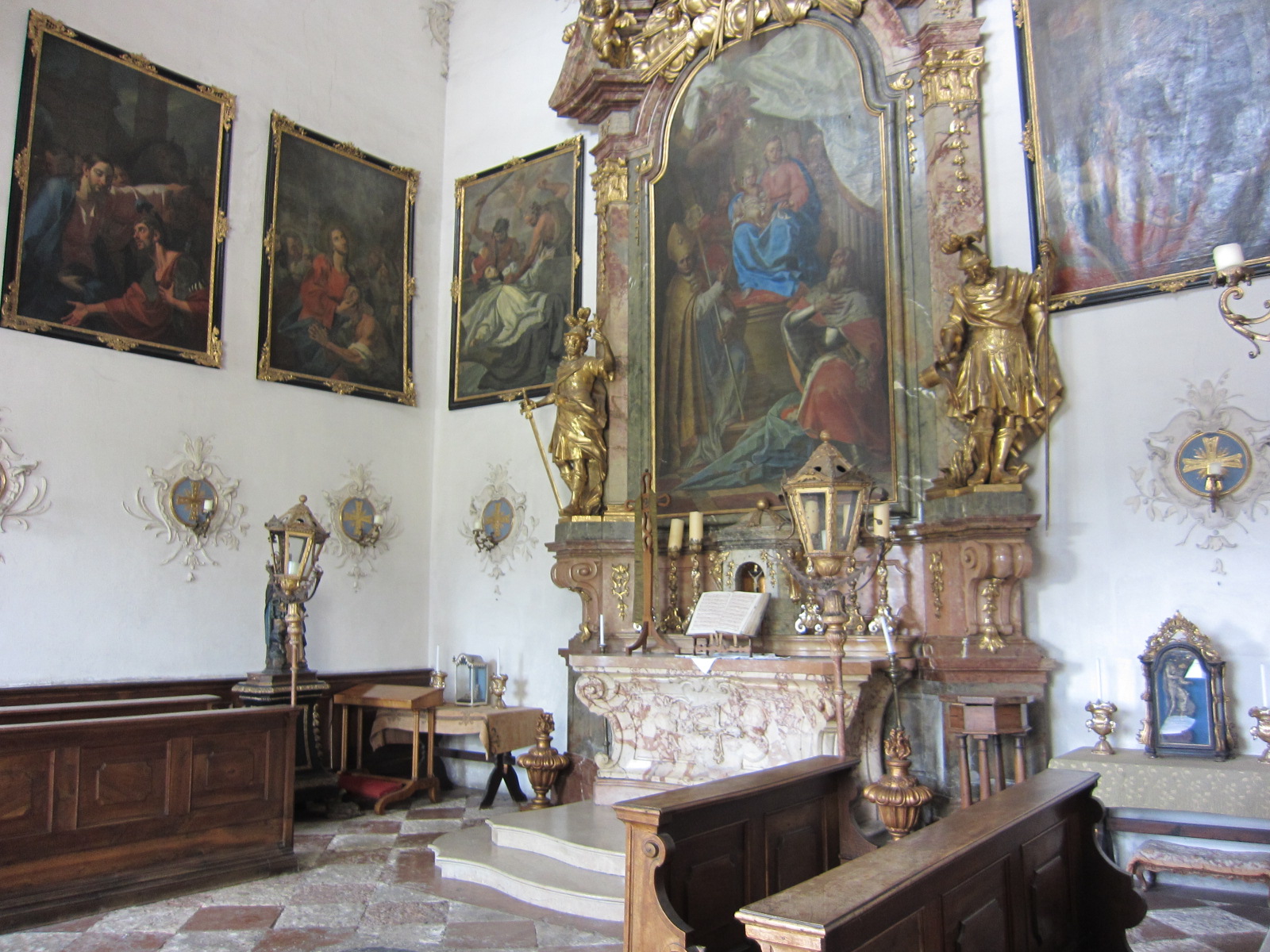
Here's some views of the original Baroque style. The chapel is one of 2 rooms left as Baroque.
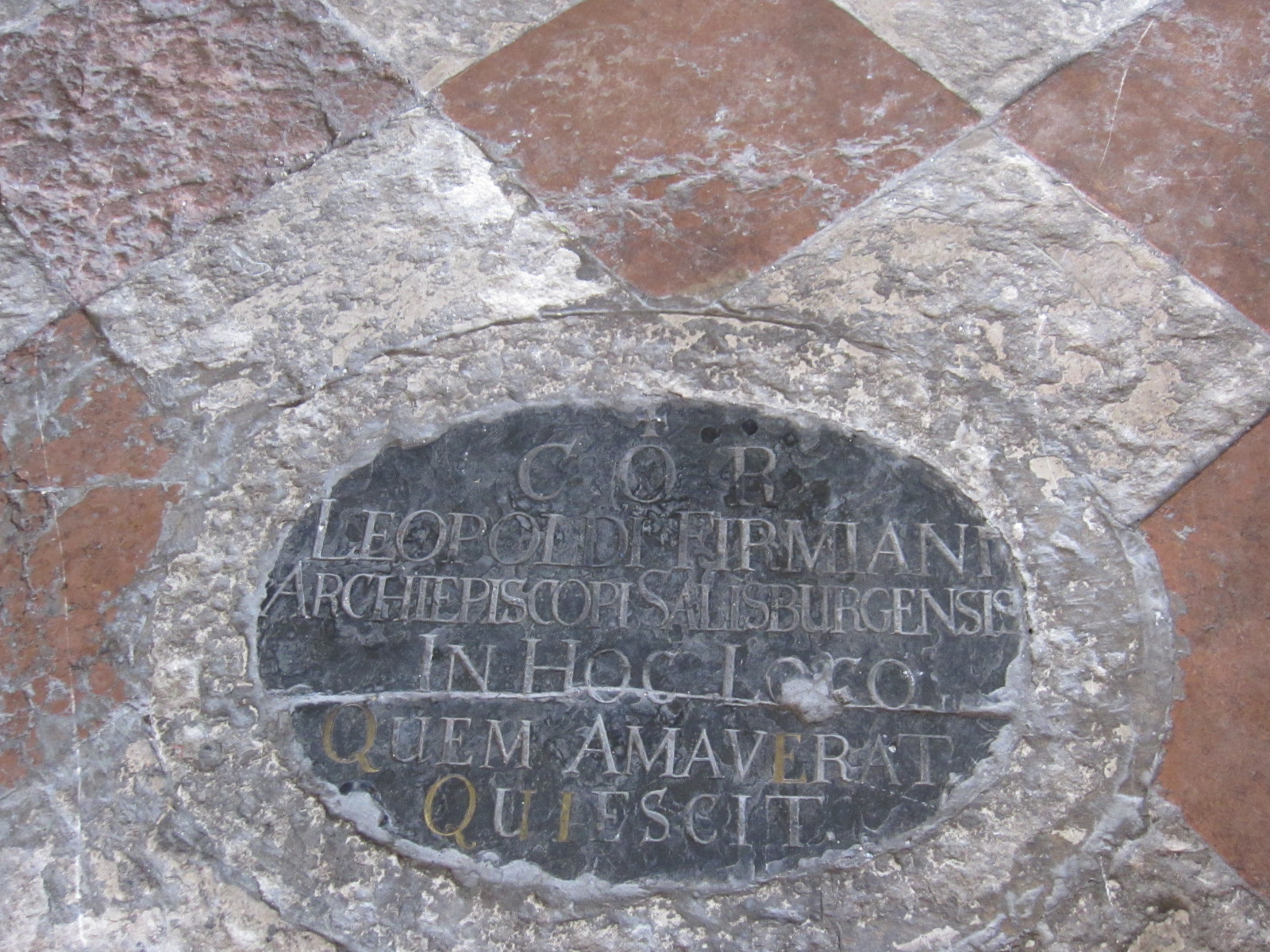
After he died he had to have his body interred in the Dom. As the Archbishop of Salzburg he had a reserved spot in the Dom crypt whether he wanted it or not. In the 18th century, however, it was trendy to bury part of yourself in places you loved or had meaning for you. So Leopold Firmian literally left his heart at Schloss Leopoldskron. In the chapel floor actually.
He left the place that he loved to his nephew, Count Laktans, who sadly did not pass it on to family upon his death.
A shooting gallery owner acquired the place when the Count died and sold off most of the pretty things like paintings, giltwork, and statues that the count and archbishop had collected. The Firmans were known as patrons of the arts. Apparently the shooting gallery owner was not. They don't know for sure if the schloss was used as a shooting gallery, but I wouldn't be surprised. Guys, guns, and money in the 19th century. You can do the math.
The shooting gallery owner didn't own it for very long. It was sold several times in the 19th century and used for different purposes.
So now we wait for the entrance of the 20th century and Max Reinhardt.
It is quite interesting(and I want to use more of the library and schloss photos I took) I'm sneaky that way. :D Here's my favorite photo of the schloss exterior. Two residences of a Prince-Archbishop of Salzburg.
So bear with me while we delve into the history of Schloss Leopoldskron. First we will set the scene with a few facts about Salzburg. Salzburg means salt castle in German. Also known as 'white gold' the salt mines in the area ensured that money poured into the region. It was one of the main reasons that Salzburg became an archbishopric so early. (Before the 1000's) Some salt mines still do operate in the region to this day. If anyone is interested in the history of salt and how important it was to the world economy check out this book, Salt, a world history by Mark Kurlansky.
So early on Salzburg had enough money to be an independent principality with an Archbishop as the head of the church and the political head of state. Known as a Prince-Archbishop until the early 1800's,(Napoleon and the Council of Vienna stripped the Prince part of the title in 1815 and Salzburg officially became a part of Austria.) they were the power in Salzburg. In fact Mozart's father was court composer to Archbishop Leopold Firmian. They even think a young Mozart played in the schloss for the Archbishop. It makes some sense, there's just no documentary evidence. Young Wolfgang played everywhere else why not at Schloss Leopoldskron for his father's patron?
So back to the early history of the schloss. Leopold Firmian... umm...acquired some land near a small lake in the countryside(he expelled a lot of the Protestants of Salzburg and gee look at all that wasted farmland) and decided to build himself a summer palace.
I gotta say this for him, he knew location. His plot of land was right between the Untersberg mountain and the city with great views of both, depending on which way you were facing. And as an added bonus it's waterfront property!
So the palace had to match both the location and the importance of the owner. As you can imagine, it took him quite some time to get exactly what he wanted.
He started it in 1736 and it was finished in 1744(right before he died) In keeping with artistic trends of the time he did it in the Baroque/rococo style. Lots of stucco work, marble, and giltwork. That man had no self-esteem issues whatsoever. Anyone who makes the Pope gasp at your audacity has a HUGE ego. (That was the whole expelling the Protestants deal.)
Here's some views of the original Baroque style. The chapel is one of 2 rooms left as Baroque.
After he died he had to have his body interred in the Dom. As the Archbishop of Salzburg he had a reserved spot in the Dom crypt whether he wanted it or not. In the 18th century, however, it was trendy to bury part of yourself in places you loved or had meaning for you. So Leopold Firmian literally left his heart at Schloss Leopoldskron. In the chapel floor actually.
He left the place that he loved to his nephew, Count Laktans, who sadly did not pass it on to family upon his death.
A shooting gallery owner acquired the place when the Count died and sold off most of the pretty things like paintings, giltwork, and statues that the count and archbishop had collected. The Firmans were known as patrons of the arts. Apparently the shooting gallery owner was not. They don't know for sure if the schloss was used as a shooting gallery, but I wouldn't be surprised. Guys, guns, and money in the 19th century. You can do the math.
The shooting gallery owner didn't own it for very long. It was sold several times in the 19th century and used for different purposes.
So now we wait for the entrance of the 20th century and Max Reinhardt.
Sunday, March 20, 2011
Sunny days


No, all the clouds were not chased away today, but the sun was out. Which was nice. It's been a while since the sun was out.
I finally managed to get photos of the schloss' exterior and some of the interior. Right before we left for Gaisberg.
Some of these views may seem familiar. I wonder if you can pinpoint exactly why. A present from the Schloss for the first person who knows. And when I say exactly I mean the chapter and verse(so to speak.)
Subscribe to:
Comments (Atom)