So I heard about a new book on NPR about a month ago. It's called Year Zero by Rob Reid.
I highly recommend it if you like copyright law, music, aliens, or movies where a mild mannered hero saves the earth at the last minute.
It's very funny. Even the footnotes! My favorite one was when they had a reference to Lawerence Lessig. (It's a librarian geek thing)
The premise is that of all the things the higher evolved aliens inhabiting the universe do, music is the one thing where they kinda suck at and we don't.
So one day one of NASA's exploratory satellites crossed the line and activated their warning system that we had become a species with reasonable intelligence(they also wanted to know if we were going to keep shooting things into the outer solar system) and started scanning our broadcast transmissions.
They weren't impressed at first with our advancement. Then It Happened! On October 27th 1977 at 8:29pm the most magical event in the universe's recorded history started. The closing theme to Welcome Back Kotter started.
You can look it up on Youtube or Wikipedia if you haven't heard about the show. Those of you who know it, go ahead laugh. But the aliens didn't. They rejoiced. Because this was better than anything they had ever heard in billions of years. Sadly, some died almost instantly because of the joy that small musical ode caused. So 30 years go by and they can't get enough of our music. Pop, jazz, rock(lots of rock) classical, and tv themes. But finally the universe has to go back to work, and then they discover something horrifying.
They owe every non North Korean human(apparently the only culture on earth that doesn't have good music) ungodly amounts of money.
Damn copyright laws.
There are 2 schools of thought being debated in the outer reaches. Figure out a way to pay us and license the music so this doesn't happen again, or blow us up(which would cancel the debt out nicely)
So our hero a mild mannered copyright lawyer needs to find a creative solution that will satisfy the masses and still allow him and his law firm to get paid.
Chaos and hilarity ensues as he travels the universe, and the byways of New York City trying to figure out a loophole in the copyright laws so the earth survives to make more music.
Saturday, September 15, 2012


Friday, December 16, 2011
Ode to an apple
With all due apologies to John Keats and Percy Bysshe Shelley it's not an ode, but more of an essay. I don't write poetry, but Essay to an apple doesn't sound right.
So apples. I like apples. I especially like MacIntosh and Courtland apples. I love the colors of them. Half red, half green with the clean white insides. They have great crunch when you bite into them. That first explosion of sound and taste. Then, the are crisp and sweetness of the white interior. I eat them raw, but they are great to cook with.
I also dug out apple recipes. Apple cake was last week and I'll make apple fritters this weekend. Those always remind me of my childhood and my grandparents. Warm apple fritters and milk. Ah, nothing better in the chill fall afternoons. Unless you are talking about homemade applesauce. So simple, so easy, so good. Apples, water, a big pot, some low heat, cinnamon, nutmeg and a strainer and you're done.
It's great on toast. I highly recommend it in yogurt too. Again something from my childhood.
Fresh picked apples in the fall. One of the joys of New England.
So apples. I like apples. I especially like MacIntosh and Courtland apples. I love the colors of them. Half red, half green with the clean white insides. They have great crunch when you bite into them. That first explosion of sound and taste. Then, the are crisp and sweetness of the white interior. I eat them raw, but they are great to cook with.
I also dug out apple recipes. Apple cake was last week and I'll make apple fritters this weekend. Those always remind me of my childhood and my grandparents. Warm apple fritters and milk. Ah, nothing better in the chill fall afternoons. Unless you are talking about homemade applesauce. So simple, so easy, so good. Apples, water, a big pot, some low heat, cinnamon, nutmeg and a strainer and you're done.
It's great on toast. I highly recommend it in yogurt too. Again something from my childhood.
Fresh picked apples in the fall. One of the joys of New England.
Tuesday, August 23, 2011
Kayaking
I've been learning how to kayak in the past few weeks. It's lots of fun. I find it relaxing as well as being really good arm exercise.
It's not exactly related to my Austrian experiences, except that while I was there I was more active. I walked, hiked up and over mountains, used the on-site gym, and did yoga, to name a few things.
I wanted to stay active when I got home. I have not done as well as I hoped, but mostly because I have less 'exercise' time since there's things like cooking, cleaning, shopping and the damn drive. I think I miss my commute to the schloss more than anything else. Yes, lazy. But it did reduce my carbon footprint a little those 2 months. :D
So back to kayaking. I've been 3 times so far. The first time I really liked it. However there was the maritime disaster. I will say that it wasn't totally my fault. Really. Thank goodness I grew up in those waters and knew how to swim. Briefly I tipped the kayak(there were circumstances....) and didn't know how to empty it. (I do now.) I had to tie the waterlogged kayak to my mom's and hope we made it in.
We had help from different sources, some of which were helpful and some, sadly were, not, but we made it in safe and sound. (A piece of advice for everyone, learn how to swim. Even a dog paddle stroke!) I had better luck the second time out. And I went out again by myself just today. I stayed out a good hour paddling around and getting comfortable.
This time I headed down the beach to Bradley Point and back. It was the back part that was harder. The current and the wind were in my face. Or bow, if you want strict nautical terms. It took some time to adjust to the waves breaking over the bow on occasion and the sun in my eyes. But once I got it I enjoyed it. Good workout for the shoulders and arms, and I like being on the water. Hell, I grew up on that beach so it'd be stranger not to be out on the water and the beach in August.
It's not exactly related to my Austrian experiences, except that while I was there I was more active. I walked, hiked up and over mountains, used the on-site gym, and did yoga, to name a few things.
I wanted to stay active when I got home. I have not done as well as I hoped, but mostly because I have less 'exercise' time since there's things like cooking, cleaning, shopping and the damn drive. I think I miss my commute to the schloss more than anything else. Yes, lazy. But it did reduce my carbon footprint a little those 2 months. :D
So back to kayaking. I've been 3 times so far. The first time I really liked it. However there was the maritime disaster. I will say that it wasn't totally my fault. Really. Thank goodness I grew up in those waters and knew how to swim. Briefly I tipped the kayak(there were circumstances....) and didn't know how to empty it. (I do now.) I had to tie the waterlogged kayak to my mom's and hope we made it in.
We had help from different sources, some of which were helpful and some, sadly were, not, but we made it in safe and sound. (A piece of advice for everyone, learn how to swim. Even a dog paddle stroke!) I had better luck the second time out. And I went out again by myself just today. I stayed out a good hour paddling around and getting comfortable.
This time I headed down the beach to Bradley Point and back. It was the back part that was harder. The current and the wind were in my face. Or bow, if you want strict nautical terms. It took some time to adjust to the waves breaking over the bow on occasion and the sun in my eyes. But once I got it I enjoyed it. Good workout for the shoulders and arms, and I like being on the water. Hell, I grew up on that beach so it'd be stranger not to be out on the water and the beach in August.
Saturday, August 20, 2011
Fiscal Sustainability
I don't usually post stuff on politics here. I don't want this to turn into a political commentary blog. But lately I've been thinking about it.
My last few weeks in Austria I searched for articles about fiscal sustainability for a session they were holding at some point. It has been on my mind in the last few weeks. And especially this weekend with the Iowa primaries gearing up.
I fear for the country if the so called Tea Party keeps hijacking government for their own agenda. I wonder how they expect us to get out of debt if they refuse to raise taxes at all? I mean it's sorta the first rule of paying down debt is to increase the money coming in. Yes, limiting your expenditures to fit your income is something everyone who works within a budget needs to do. But when you have more debt than income you need to get another job or get a raise somehow.
But this is a foreign concept for some members of the elected government. Yes, we should cut back certain areas of spending in government. I know there have to be some programs that have run their course and are no longer useful or can be sustained without government money. An independent audit would be the best way to go. We need people who aren't influenced by political ideology, future power, or the media spotlight.
Yes, what we need are (brace yourselves) experts. I know, horrors! It's unheard of. Having people who are trained in these things and have spent years perfecting their skills helping people, businesses, universities, non-profit organizations, churches, and smaller governments live within their means advise the federal government to do the same.
It's only common sense, which the Tea Party claims to embrace. But their actions this last week or so make their words a lie.
I don't want my plumber doing my taxes, or a car mechanic giving me a physical. So why do we trust a journalist to tell us about religion, or a professional athlete to be a military strategist? When did education and expertise become anathema? And a better question is why?
My last few weeks in Austria I searched for articles about fiscal sustainability for a session they were holding at some point. It has been on my mind in the last few weeks. And especially this weekend with the Iowa primaries gearing up.
I fear for the country if the so called Tea Party keeps hijacking government for their own agenda. I wonder how they expect us to get out of debt if they refuse to raise taxes at all? I mean it's sorta the first rule of paying down debt is to increase the money coming in. Yes, limiting your expenditures to fit your income is something everyone who works within a budget needs to do. But when you have more debt than income you need to get another job or get a raise somehow.
But this is a foreign concept for some members of the elected government. Yes, we should cut back certain areas of spending in government. I know there have to be some programs that have run their course and are no longer useful or can be sustained without government money. An independent audit would be the best way to go. We need people who aren't influenced by political ideology, future power, or the media spotlight.
Yes, what we need are (brace yourselves) experts. I know, horrors! It's unheard of. Having people who are trained in these things and have spent years perfecting their skills helping people, businesses, universities, non-profit organizations, churches, and smaller governments live within their means advise the federal government to do the same.
It's only common sense, which the Tea Party claims to embrace. But their actions this last week or so make their words a lie.
I don't want my plumber doing my taxes, or a car mechanic giving me a physical. So why do we trust a journalist to tell us about religion, or a professional athlete to be a military strategist? When did education and expertise become anathema? And a better question is why?
Monday, August 15, 2011
More Leopoldskron history
There were several interesting stories that I learned about the schloss that I just had to share. One was in the Reinhardt days and two were from WWII.
The first one was about a particular statue that Reinhardt bought to furnish his palace. Remember the schloss had changed hands often and the art work was sold off through the centuries.
Max was a director and an artist, but he also was a businessman. He had enough money to buy and rebuild the schloss...
He had seen this statue over a building in Vienna and liked it. He thought it would be great for his entrance hall(the Great Hall we call it now). He wasn't able to buy it himself, so he sent a trusted cousin(female) to do the transaction. No one is sure exactly why, but maybe because she would be underestimated by the owner of the statue.
So she knocks on the door and says that Max Reinhardt really likes your Madonna and would like to have it. The owner of the house refuses saying the Madonna is protecting my girls. The cousin(who's name I never got) is a bit taken aback and realizes the sign is advertising a brothel. So oops. But after going back to Max and then back to the owner of the brothel(realizing maybe that she has a price for this along with everything else). She did. So Max got his Madonna. I don't know what he paid for it in the end, but it is very nice.
So the next little vignette takes place in the 1940's. The Schloss was seized by the Nazi's after the Anschluss. The schloss was fought over by member of the Nazi party. It was used a staging area for people who were going to the Eagle's Nest in Berchtesgarten. (Berchtesgarten is on the other side of the Untersberg so close...) But a Princess who was a fan of Reinhardt managed to finagle the schloss for a while and shipped out most of Max's things to him in California. I don't know how, and would love to know. Because it was 16 crates of stuff. She got 16 crates of an enemy of Nazi Germany(and a Jew) stuff across war torn Europe to California. I mean this wasn't just a few suitcases of clothes and paying a extra baggage fee on Lufthansa!
This blows my mind. 16 crates of stuff! Across war torn Europe! To a Jewish director in the USA!
The final story had evidence scattered around the schloss. This was late in the war. An American bomber was flying over the area and was looking to drop his bomb. Engine trouble I think. He saw the lake and thought, Oh good a lake. So he dropped the bomb. Well the lake isn't really deep. So he blew most of the water out of it and the concussion broke all the windows in the lake side part of the schloss. So many areas have holes in the walls. My favorite is in the White Room. One of the portraits looks like he has a GSW in the forehead.
I don't have a photo of that, but here's one from the Chinese room.

The first one was about a particular statue that Reinhardt bought to furnish his palace. Remember the schloss had changed hands often and the art work was sold off through the centuries.
Max was a director and an artist, but he also was a businessman. He had enough money to buy and rebuild the schloss...
He had seen this statue over a building in Vienna and liked it. He thought it would be great for his entrance hall(the Great Hall we call it now). He wasn't able to buy it himself, so he sent a trusted cousin(female) to do the transaction. No one is sure exactly why, but maybe because she would be underestimated by the owner of the statue.
So she knocks on the door and says that Max Reinhardt really likes your Madonna and would like to have it. The owner of the house refuses saying the Madonna is protecting my girls. The cousin(who's name I never got) is a bit taken aback and realizes the sign is advertising a brothel. So oops. But after going back to Max and then back to the owner of the brothel(realizing maybe that she has a price for this along with everything else). She did. So Max got his Madonna. I don't know what he paid for it in the end, but it is very nice.
So the next little vignette takes place in the 1940's. The Schloss was seized by the Nazi's after the Anschluss. The schloss was fought over by member of the Nazi party. It was used a staging area for people who were going to the Eagle's Nest in Berchtesgarten. (Berchtesgarten is on the other side of the Untersberg so close...) But a Princess who was a fan of Reinhardt managed to finagle the schloss for a while and shipped out most of Max's things to him in California. I don't know how, and would love to know. Because it was 16 crates of stuff. She got 16 crates of an enemy of Nazi Germany(and a Jew) stuff across war torn Europe to California. I mean this wasn't just a few suitcases of clothes and paying a extra baggage fee on Lufthansa!
This blows my mind. 16 crates of stuff! Across war torn Europe! To a Jewish director in the USA!
The final story had evidence scattered around the schloss. This was late in the war. An American bomber was flying over the area and was looking to drop his bomb. Engine trouble I think. He saw the lake and thought, Oh good a lake. So he dropped the bomb. Well the lake isn't really deep. So he blew most of the water out of it and the concussion broke all the windows in the lake side part of the schloss. So many areas have holes in the walls. My favorite is in the White Room. One of the portraits looks like he has a GSW in the forehead.
I don't have a photo of that, but here's one from the Chinese room.

Thursday, August 4, 2011
Chocolate
One of the other interns told me about this great chocolate shop near the center of town. Zotter. Or as I call it, the most dangerous shop in Austria.
The stuff they sell is sooooo good. They do have some very unusual flavor combinations. Rose and basil? Pineapple and cashew? A bacon chocolate bar? Rose flavored chocolate? But there are also more traditional flavors like hazelnut or rum coconut chocolate.
Those are the handscooped chocolate bars they sell. For different seasons they bring out different and limited edition flavors. I was there for the Easter flavors. There was one with strawberry ganache and strawberry chocolate. The best one was called (English translation) Easter Fire. It was dark chocolate with eggnog flavored filling with chili peppers. AMAZING.
Okay not everyone liked it. But hey that's life.
One of the things I really liked about the bars(other than the chocolate itself) was the artwork on the wrapper. I have some shots of them. Fun and attention getting. Although if you don't speak German and you haven't tried that one before it could be risky.


They also make handmade chocolates and have something called a ChocoShot(it's a syringe filled with chocolate) for those days when you really need a pick me up.
And the best part about Zotter? Two words...free samples. Ah, Zotter.
And they are very conscious about the whole fair trade deal. They say they buy right from the farmers mostly in Latin America and also use other organic products to make their chocolate products. That's very typical in Austria. The very organic and local mindset about their food. They have 2 markets in Salzburg. The main one near Schloss Mirabelle and the Green market near the University Square. Two farmer's markets everyday! Except Sundays. It's great. I realized it can be very easy to be vegetarian in Salzburg because of that. Lots of fruits, nuts and veggies of all kinds. Cheeses and breads fresh made and in the case of bread still warm. But that's another story...
The stuff they sell is sooooo good. They do have some very unusual flavor combinations. Rose and basil? Pineapple and cashew? A bacon chocolate bar? Rose flavored chocolate? But there are also more traditional flavors like hazelnut or rum coconut chocolate.
Those are the handscooped chocolate bars they sell. For different seasons they bring out different and limited edition flavors. I was there for the Easter flavors. There was one with strawberry ganache and strawberry chocolate. The best one was called (English translation) Easter Fire. It was dark chocolate with eggnog flavored filling with chili peppers. AMAZING.
Okay not everyone liked it. But hey that's life.
One of the things I really liked about the bars(other than the chocolate itself) was the artwork on the wrapper. I have some shots of them. Fun and attention getting. Although if you don't speak German and you haven't tried that one before it could be risky.


They also make handmade chocolates and have something called a ChocoShot(it's a syringe filled with chocolate) for those days when you really need a pick me up.
And the best part about Zotter? Two words...free samples. Ah, Zotter.
And they are very conscious about the whole fair trade deal. They say they buy right from the farmers mostly in Latin America and also use other organic products to make their chocolate products. That's very typical in Austria. The very organic and local mindset about their food. They have 2 markets in Salzburg. The main one near Schloss Mirabelle and the Green market near the University Square. Two farmer's markets everyday! Except Sundays. It's great. I realized it can be very easy to be vegetarian in Salzburg because of that. Lots of fruits, nuts and veggies of all kinds. Cheeses and breads fresh made and in the case of bread still warm. But that's another story...
Monday, August 1, 2011
Leopoldskron part 2 or is it 3?
So now that we have some background on the owners and history of the schloss you understand the context of the place.
And as any good archivist knows, "Context is everything."
I mentioned that Max spent a great deal of time and money renovating the schloss. He created the library and redid the dining room with a Venetian theme.
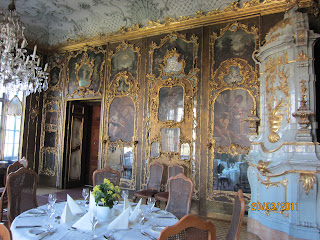
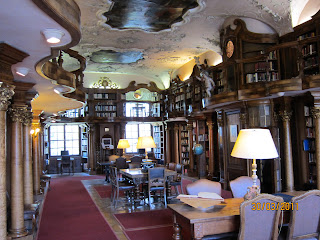
 And just in case you wondered who built the library he had a signature of sorts plastered into the ceiling in the very classic sign for the theatre. The mask on the left is a portrait of Max himself.
He also built an ampitheatre in the park so he could stage plays. Sadly the theatre was not built on solid ground and sank years ago, although there are still signs of it if you know where to look.
In fact the schloss itself was not built on solid ground, but the Archbishop took a page from the builders of Venice and used supports in the boggy ground to be the bedrock and foundation of the place. A problem with waterfront property, I guess.
After the Second World War was over the schloss was returned to Reinhardt's heirs. His widow offered the use of the place to several Harvard(yes I know...)grad students who came up with what is now referred to as the "Marshall Plan for the mind" to get former enemies to share ideas, cultures, and trust each other again. The Seminar was supposed to be a one time thing, but it was so popular with the participants that it continued on. Obviously. There have been some rather important people who attended sessions there. The Prince of Wales, and Ralph Ellison were two that I knew about from research(and cleaning) in the office. So it's very diverse.
The organization that runs the Seminar bought the place in the 1960's and so here we are. At least when it comes to ownership.
It was designated a historical place of interest by the Austrian government sometime back. From an artistic and historical standpoint you gotta love that.
And as any good archivist knows, "Context is everything."
I mentioned that Max spent a great deal of time and money renovating the schloss. He created the library and redid the dining room with a Venetian theme.


He also built an ampitheatre in the park so he could stage plays. Sadly the theatre was not built on solid ground and sank years ago, although there are still signs of it if you know where to look.
In fact the schloss itself was not built on solid ground, but the Archbishop took a page from the builders of Venice and used supports in the boggy ground to be the bedrock and foundation of the place. A problem with waterfront property, I guess.
After the Second World War was over the schloss was returned to Reinhardt's heirs. His widow offered the use of the place to several Harvard(yes I know...)grad students who came up with what is now referred to as the "Marshall Plan for the mind" to get former enemies to share ideas, cultures, and trust each other again. The Seminar was supposed to be a one time thing, but it was so popular with the participants that it continued on. Obviously. There have been some rather important people who attended sessions there. The Prince of Wales, and Ralph Ellison were two that I knew about from research(and cleaning) in the office. So it's very diverse.
The organization that runs the Seminar bought the place in the 1960's and so here we are. At least when it comes to ownership.
It was designated a historical place of interest by the Austrian government sometime back. From an artistic and historical standpoint you gotta love that.
Sunday, July 31, 2011
Reinhardt and Leopoldskron
So now that you have the basics of how the schloss came to be it's time to move to the 20th century. So here enters the hero of the piece.
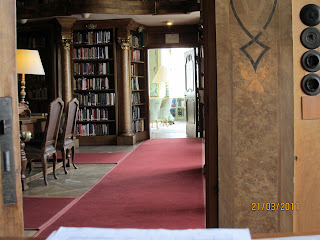
After the First World War Max Reinhardt bought the schloss and spent the next 20 years and a great deal of money renovating. As someone who spent the majority of her time in his office I can attest that it was worth every cent and second he lavished on the place. Here's one of my favorite views. This is looking out to the library from the Reinhardt office.
 Many people have not heard of Max Reinhardt these days. So here's a few facts about him(thanks to the finding aid of the SUNY- Binghamton Special Collections, which holds the Reinhardt archives) Max Reinhardt started his work life as an actor. He was best known for his portrayals of old men, but he quickly tired of the scripts and the style of acting at the time and founded his own theatre in 1901. Known as Schall und Rauch it helped Max develop a directorial style for his later years. He moved around from Vienna, Salzburg, and Berlin during this time.
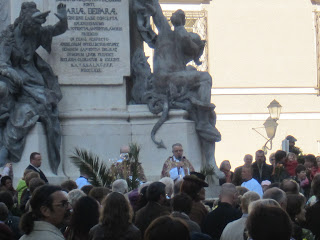
He quickly became a well known director who used new technologies and experimented with locations for his productions. This came in handy when he and Richard Wagner and Hugo von Hofmannsthal revived and expanded the Salzburg Festspiele. Reinhardt convinced the Archbishop to let him direct Hofmannsthal's play Jedermann(Everyman) in front of the Dom Cathedral to open the Festival. This is something they still do today at the opening of every festival, unless it rains, of course. Here's a shot of the front of the Dom on Palm Sunday. A partial view of what it could be like for the play.
After the war he left Berlin for Salzburg where he lived until 1938. As a Jew he was unwelcome in Austria after the Anschluss. All his property including Leopoldskron was seized by the Nazis because he was considered an enemy of the state. Luckily for Max he was in the U.S. at the time where he lived in until his death in 1943 at the age of 70. Some think losing the schloss broke his heart. I don't know about that, but it is known that he was saddened by it's loss to the Nazis. When his possessions(all 16 crates of them) were returned to him by an admirer he replied to her "Thank you, but what are 16 crates when one has lost Leopoldskron?".
So the schloss is still working it's magic on the owner. Like the original owner it was hard to leave the place that he loved.
After the First World War Max Reinhardt bought the schloss and spent the next 20 years and a great deal of money renovating. As someone who spent the majority of her time in his office I can attest that it was worth every cent and second he lavished on the place. Here's one of my favorite views. This is looking out to the library from the Reinhardt office.

He quickly became a well known director who used new technologies and experimented with locations for his productions. This came in handy when he and Richard Wagner and Hugo von Hofmannsthal revived and expanded the Salzburg Festspiele. Reinhardt convinced the Archbishop to let him direct Hofmannsthal's play Jedermann(Everyman) in front of the Dom Cathedral to open the Festival. This is something they still do today at the opening of every festival, unless it rains, of course. Here's a shot of the front of the Dom on Palm Sunday. A partial view of what it could be like for the play.

After the war he left Berlin for Salzburg where he lived until 1938. As a Jew he was unwelcome in Austria after the Anschluss. All his property including Leopoldskron was seized by the Nazis because he was considered an enemy of the state. Luckily for Max he was in the U.S. at the time where he lived in until his death in 1943 at the age of 70. Some think losing the schloss broke his heart. I don't know about that, but it is known that he was saddened by it's loss to the Nazis. When his possessions(all 16 crates of them) were returned to him by an admirer he replied to her "Thank you, but what are 16 crates when one has lost Leopoldskron?".
So the schloss is still working it's magic on the owner. Like the original owner it was hard to leave the place that he loved.
Friday, July 29, 2011
Schloss Leopoldskron
I can't remember if I posted anything about the history of the schloss. I don't think so. Not as a dedicated entry, of course. I know there were hints.
It is quite interesting(and I want to use more of the library and schloss photos I took) I'm sneaky that way. :D Here's my favorite photo of the schloss exterior. Two residences of a Prince-Archbishop of Salzburg.

So bear with me while we delve into the history of Schloss Leopoldskron. First we will set the scene with a few facts about Salzburg. Salzburg means salt castle in German. Also known as 'white gold' the salt mines in the area ensured that money poured into the region. It was one of the main reasons that Salzburg became an archbishopric so early. (Before the 1000's) Some salt mines still do operate in the region to this day. If anyone is interested in the history of salt and how important it was to the world economy check out this book, Salt, a world history by Mark Kurlansky.
So early on Salzburg had enough money to be an independent principality with an Archbishop as the head of the church and the political head of state. Known as a Prince-Archbishop until the early 1800's,(Napoleon and the Council of Vienna stripped the Prince part of the title in 1815 and Salzburg officially became a part of Austria.) they were the power in Salzburg. In fact Mozart's father was court composer to Archbishop Leopold Firmian. They even think a young Mozart played in the schloss for the Archbishop. It makes some sense, there's just no documentary evidence. Young Wolfgang played everywhere else why not at Schloss Leopoldskron for his father's patron?
So back to the early history of the schloss. Leopold Firmian... umm...acquired some land near a small lake in the countryside(he expelled a lot of the Protestants of Salzburg and gee look at all that wasted farmland) and decided to build himself a summer palace.
 I gotta say this for him, he knew location. His plot of land was right between the Untersberg mountain and the city with great views of both, depending on which way you were facing. And as an added bonus it's waterfront property!
So the palace had to match both the location and the importance of the owner. As you can imagine, it took him quite some time to get exactly what he wanted.
He started it in 1736 and it was finished in 1744(right before he died) In keeping with artistic trends of the time he did it in the Baroque/rococo style. Lots of stucco work, marble, and giltwork. That man had no self-esteem issues whatsoever. Anyone who makes the Pope gasp at your audacity has a HUGE ego. (That was the whole expelling the Protestants deal.)
Here's some views of the original Baroque style. The chapel is one of 2 rooms left as Baroque.
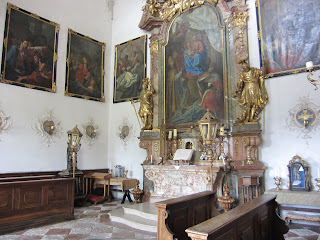

After he died he had to have his body interred in the Dom. As the Archbishop of Salzburg he had a reserved spot in the Dom crypt whether he wanted it or not. In the 18th century, however, it was trendy to bury part of yourself in places you loved or had meaning for you. So Leopold Firmian literally left his heart at Schloss Leopoldskron. In the chapel floor actually.
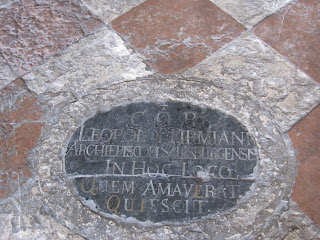
He left the place that he loved to his nephew, Count Laktans, who sadly did not pass it on to family upon his death.
A shooting gallery owner acquired the place when the Count died and sold off most of the pretty things like paintings, giltwork, and statues that the count and archbishop had collected. The Firmans were known as patrons of the arts. Apparently the shooting gallery owner was not. They don't know for sure if the schloss was used as a shooting gallery, but I wouldn't be surprised. Guys, guns, and money in the 19th century. You can do the math.
The shooting gallery owner didn't own it for very long. It was sold several times in the 19th century and used for different purposes.
So now we wait for the entrance of the 20th century and Max Reinhardt.
It is quite interesting(and I want to use more of the library and schloss photos I took) I'm sneaky that way. :D Here's my favorite photo of the schloss exterior. Two residences of a Prince-Archbishop of Salzburg.

So bear with me while we delve into the history of Schloss Leopoldskron. First we will set the scene with a few facts about Salzburg. Salzburg means salt castle in German. Also known as 'white gold' the salt mines in the area ensured that money poured into the region. It was one of the main reasons that Salzburg became an archbishopric so early. (Before the 1000's) Some salt mines still do operate in the region to this day. If anyone is interested in the history of salt and how important it was to the world economy check out this book, Salt, a world history by Mark Kurlansky.
So early on Salzburg had enough money to be an independent principality with an Archbishop as the head of the church and the political head of state. Known as a Prince-Archbishop until the early 1800's,(Napoleon and the Council of Vienna stripped the Prince part of the title in 1815 and Salzburg officially became a part of Austria.) they were the power in Salzburg. In fact Mozart's father was court composer to Archbishop Leopold Firmian. They even think a young Mozart played in the schloss for the Archbishop. It makes some sense, there's just no documentary evidence. Young Wolfgang played everywhere else why not at Schloss Leopoldskron for his father's patron?
So back to the early history of the schloss. Leopold Firmian... umm...acquired some land near a small lake in the countryside(he expelled a lot of the Protestants of Salzburg and gee look at all that wasted farmland) and decided to build himself a summer palace.

So the palace had to match both the location and the importance of the owner. As you can imagine, it took him quite some time to get exactly what he wanted.
He started it in 1736 and it was finished in 1744(right before he died) In keeping with artistic trends of the time he did it in the Baroque/rococo style. Lots of stucco work, marble, and giltwork. That man had no self-esteem issues whatsoever. Anyone who makes the Pope gasp at your audacity has a HUGE ego. (That was the whole expelling the Protestants deal.)
Here's some views of the original Baroque style. The chapel is one of 2 rooms left as Baroque.
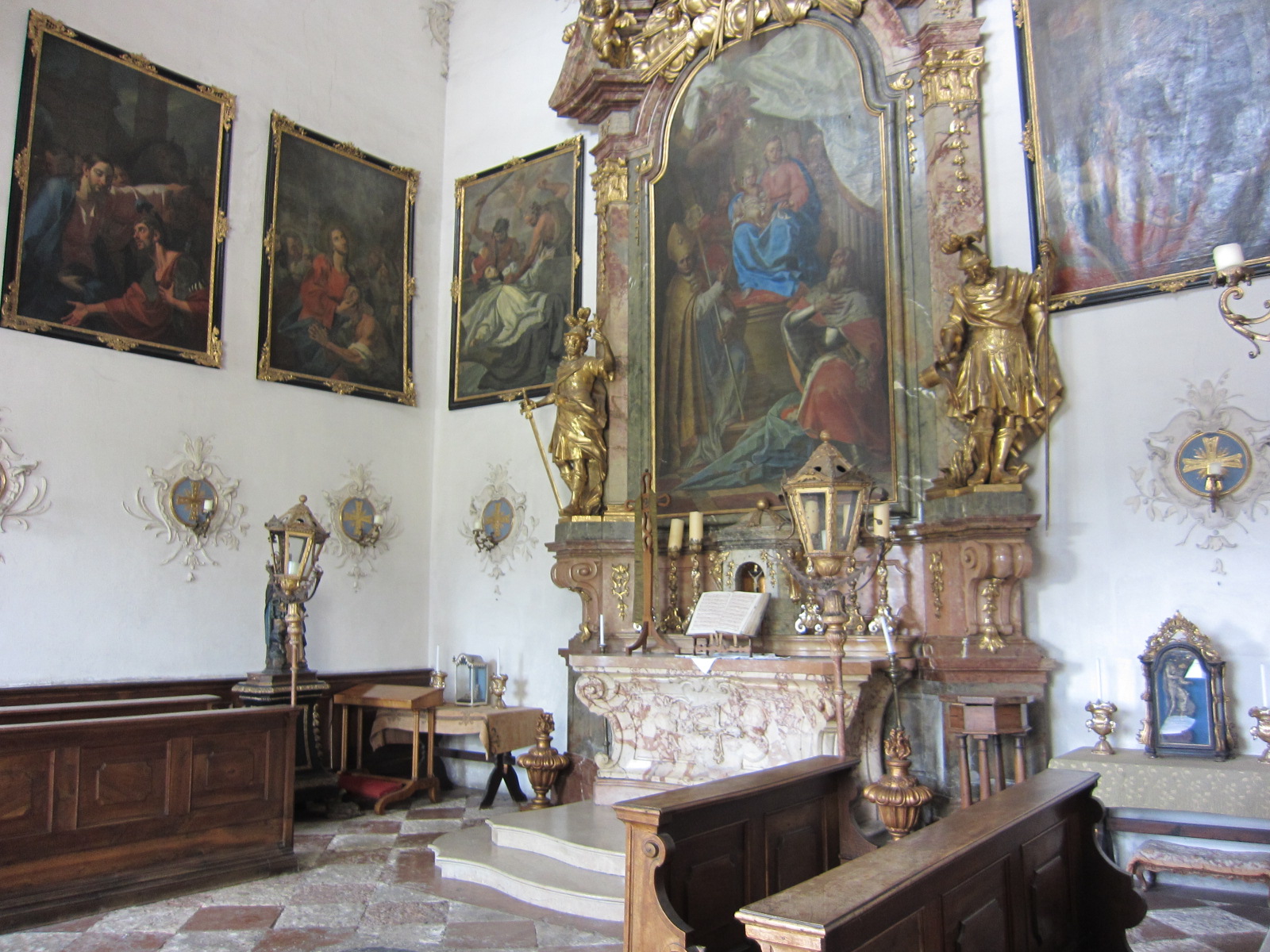

After he died he had to have his body interred in the Dom. As the Archbishop of Salzburg he had a reserved spot in the Dom crypt whether he wanted it or not. In the 18th century, however, it was trendy to bury part of yourself in places you loved or had meaning for you. So Leopold Firmian literally left his heart at Schloss Leopoldskron. In the chapel floor actually.
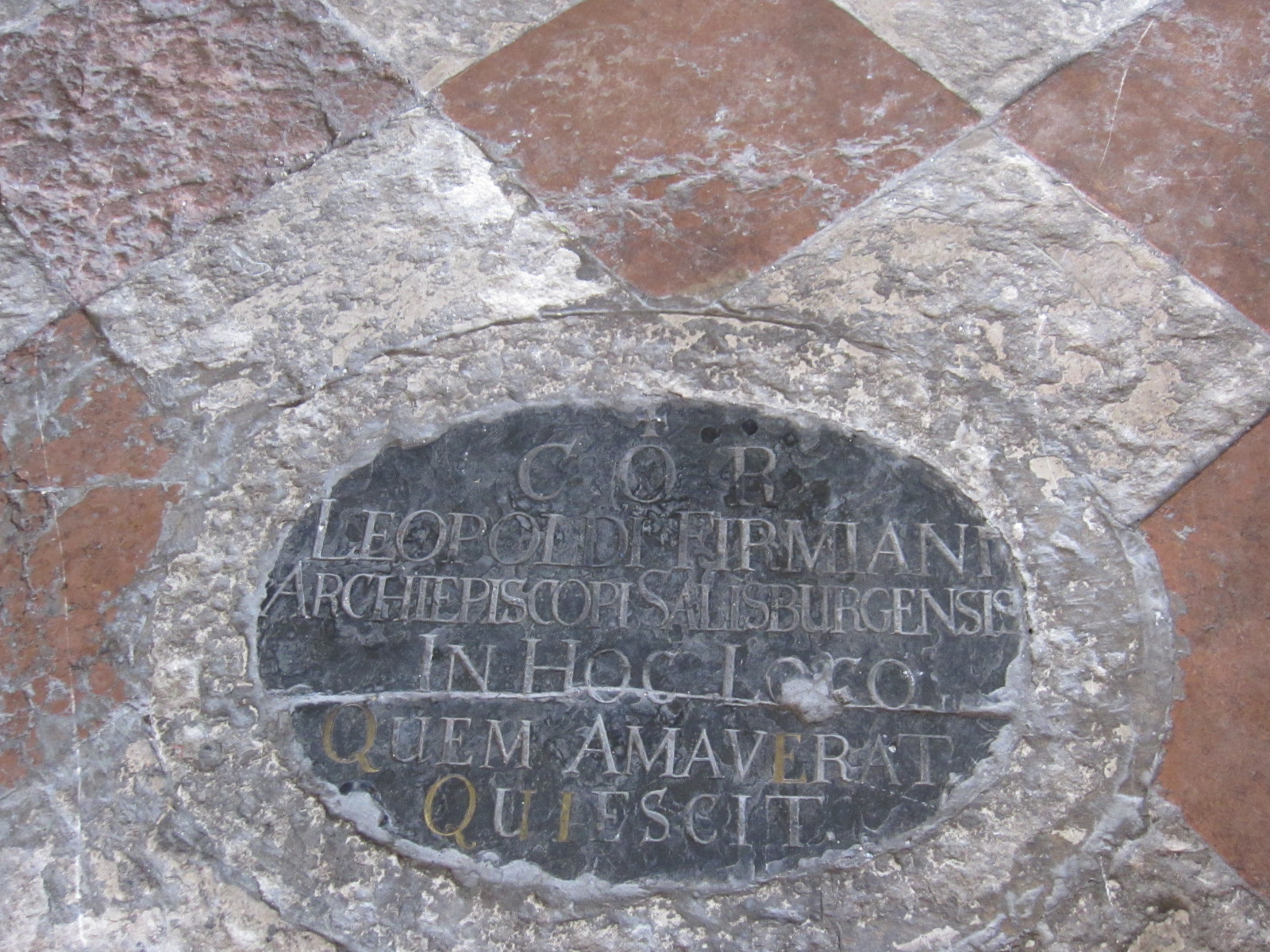
He left the place that he loved to his nephew, Count Laktans, who sadly did not pass it on to family upon his death.
A shooting gallery owner acquired the place when the Count died and sold off most of the pretty things like paintings, giltwork, and statues that the count and archbishop had collected. The Firmans were known as patrons of the arts. Apparently the shooting gallery owner was not. They don't know for sure if the schloss was used as a shooting gallery, but I wouldn't be surprised. Guys, guns, and money in the 19th century. You can do the math.
The shooting gallery owner didn't own it for very long. It was sold several times in the 19th century and used for different purposes.
So now we wait for the entrance of the 20th century and Max Reinhardt.
Monday, July 4, 2011
Playing catch-up
I didn't get to post everything I wanted to about Austria and Salzburg before I left, and I had so much going on when I came back that I didn't get to do all of it. Sorry about that!
One such post was about the oil and vinegar store in Goldgasse. I had read about it in my guide book and it was highly recommended. As well as by some people at the schloss. I took some time off from the library the week I was scheduled to return home to do some shopping things...
Well, I went to the bakery at St. Peter's(yummy brioche) then to the store. By the way if you are in Salzburg, go to the bakery. It's the oldest in Salzburg and they use a wood fired oven. Gotta hand it to those monks...they know good bread.
Anyway back to the store. It's called Vom Fass and it's one of those places you could spend ages in. They just don't have oils and vinegars. They sell sherry and whisky as well. I just tried several different vinegars and oils. It WAS still morning...and I had to go back to the library. You taste and try different things. You pick your own bottles(I went with the plain square kind for transport, but the shoe shaped one tempted me) and they fill them with what ever you choose right from the cask. That's what Vom Fass means. From the Cask.
The apple cider vinegar redefined my understanding of what vinegar should be. As the owner promised!
The raspberry vinegar was sweet and tangy, perfect for a salad dressing. I had lemonade without the sugar when the owner added a lemon- lime vinegar to my bottle of water. AMAZING. I mean I had no idea you could have vinegar that tastes like that. And I don't always like vinegars, but I loved these.
The beer vinegar has more of a tang than some of the others I tried. It has the beer aftertaste. Malty actually. It hits in the back of the throat. The owner told me it's really good to marinate beef in.
I tried aged balsamic and finally decided that my brother would prefer the beer vinegar over aged balsamic.
The hazelnut oil is perfect with ice cream. I have an idea to use it in a recipe with chicken. I'll let you know.
And the funniest part was when I was choosing the stuff to bring home. He had run out of the apple cider vinegar and had to replace the cask. So I browsed around the front and near the register I see this photo of the store owner and Mark Harmon(you know from NCIS.) Well, if not you can google him. Apparently he and his wife were on vacation in Salzburg and wandering the Goldgasse when the guy recognized him. He went out and spoke to him. Asked him if he was who he thought he was. Harmon ended up looking in the store(don't know if he bought anything) and taking the photo. One more reason I loved that store.
One such post was about the oil and vinegar store in Goldgasse. I had read about it in my guide book and it was highly recommended. As well as by some people at the schloss. I took some time off from the library the week I was scheduled to return home to do some shopping things...
Well, I went to the bakery at St. Peter's(yummy brioche) then to the store. By the way if you are in Salzburg, go to the bakery. It's the oldest in Salzburg and they use a wood fired oven. Gotta hand it to those monks...they know good bread.
Anyway back to the store. It's called Vom Fass and it's one of those places you could spend ages in. They just don't have oils and vinegars. They sell sherry and whisky as well. I just tried several different vinegars and oils. It WAS still morning...and I had to go back to the library. You taste and try different things. You pick your own bottles(I went with the plain square kind for transport, but the shoe shaped one tempted me) and they fill them with what ever you choose right from the cask. That's what Vom Fass means. From the Cask.
The apple cider vinegar redefined my understanding of what vinegar should be. As the owner promised!
The raspberry vinegar was sweet and tangy, perfect for a salad dressing. I had lemonade without the sugar when the owner added a lemon- lime vinegar to my bottle of water. AMAZING. I mean I had no idea you could have vinegar that tastes like that. And I don't always like vinegars, but I loved these.
The beer vinegar has more of a tang than some of the others I tried. It has the beer aftertaste. Malty actually. It hits in the back of the throat. The owner told me it's really good to marinate beef in.
I tried aged balsamic and finally decided that my brother would prefer the beer vinegar over aged balsamic.
The hazelnut oil is perfect with ice cream. I have an idea to use it in a recipe with chicken. I'll let you know.
And the funniest part was when I was choosing the stuff to bring home. He had run out of the apple cider vinegar and had to replace the cask. So I browsed around the front and near the register I see this photo of the store owner and Mark Harmon(you know from NCIS.) Well, if not you can google him. Apparently he and his wife were on vacation in Salzburg and wandering the Goldgasse when the guy recognized him. He went out and spoke to him. Asked him if he was who he thought he was. Harmon ended up looking in the store(don't know if he bought anything) and taking the photo. One more reason I loved that store.
Subscribe to:
Posts (Atom)
